In my last blog post, I touched on my experience with
Network Appliance filers and remote server monitoring. This week, I will be discussing alternative storage solutions, and how they measure up to one of the biggest players in the Network Attached Storage space.
I can’t recall how often I’ve been asked by users the question, “Why is enterprise storage so expensive”? After all, 2TB hard disks can be found online nowadays for less than 5 cents per gigabyte. To answer that question, we have to define exactly what Enterprise Storage is, and how it differs from consumer grade solutions.
1. Scalability. Budgets are tight, and typically projects will allow breathing room for only near to mid-term growth. So it is essential that the storage solution maximizes investment protection to avoid costly forklift upgrades.
2. Redundancy. Whether the data consists of corporate emails, accounting & financial information, or engineering designs, downtime or data loss is not an option. Redundancy across all subsystems ensures continuous operation.
3. Security. Does the storage system run a hardened OS? Are potential vulnerabilities addressed quickly? In addition, how well does the storage system integrate with other authentication and authorization systems?
4. Interoperability. As I mentioned previously, storage companies such as Network Appliance do extensive testing against a wide array of applications.
5. Performance. Enterprise storage systems support dozens if not hundreds of simultaneous users. Alternatively, they may be used to host databases or other intensive applications.
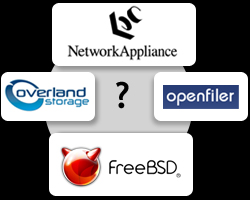
Given these requirements, what options exist out there today? There seems to be 4 distinct tiers: High end solutions, such as Network Appliance, EMC, Hitachi, Mid grade solutions, such as Overland and QNAP, Free solutions such as Openfiler or FreeNAS, or Roll-your-own solutions such as a linux or FreeBSD box.
|
Scalability |
Redundancy |
Security |
Interoperability |
Cost |
| High-End |
Great – Assortment of models / capacity |
Great – fully redundant, double parity, multi-domain I/O |
Great – Patches Provided |
Great – wide app support |
Poor – >$30k |
| Mid-Grade |
Good – Limited capacity/models |
Good – May not support double parity or multi-domain I/O |
Great – Patches Provided |
Good – limited app support |
Good – <$30k |
| Free |
Varies – potentially scales well |
Varies – potentially fully redundant |
Good/Poor- Patches may be slow |
Poor – No app support |
Great – $0 |
| Roll Your Own |
Varies – potentially scales well |
Varies – potentially fully redundant |
Poor – User is responsible |
Poor – No app support |
Great – $0 |
This is an over-simplification of the different products however. Certain solutions may have extensive features where others fall short. Customers should always review their business requirements and if possible, perform a product evaluation. In general, my suggestion is this — If a customer has sufficient manpower and technical expertise in linux server management, and if the applications in the environment are mostly homegrown, then going with a free or roll-your-own solution could work out well. However, if resources are thin, and the applications being used in house are mainstream, then the features provided by a mid to high end solution could save the staff lots of unnecessary headaches.
Next time I’ll talk about creating a roll your own solution, and some pitfalls you may encounter along the way.
SPK and Associates are experts in IT engineering, and can provide IT services such as
Engineering Tools Management, and IT consulting to help you determine which enterprise storage system is right for you.
Subscribe to our blog to keep informed on Engineering Applications, remote server management, and other topics of interest to IT and engineering professionals.
Mike Solinap
Sr. Systems Integrator, SPK