

Structuring ideas and aligning discovery work with delivery goals is crucial for product managers, but it’s not always easy. Atlassian’s Jira Product Discovery (JPD) has become a go-to solution for organizing ideas, insights, and roadmaps within a unified platform. Now, with the introduction of hierarchies in JPD, product teams can visualize how every idea, opportunity, and experiment connects to larger initiatives. This evolution brings new clarity and traceability to the product management process, helping teams prioritize with precision and collaborate with greater context.

Core Jira Product Discovery Features
Jira Product Discovery was designed to give product managers a structured, flexible, and insight-driven environment for managing product ideas before they reach developers’ backlogs. Here are the main features of the software:
Ideas and Insights
Capture opportunities, feature requests, customer insights, and research all in one place. No more scattered spreadsheets or note files as JPD centralizes discovery work.
Custom Fields and Formulas
Use fields like impact, effort, and confidence (or create your own) to prioritize ideas that deliver the most value. You can even apply scoring frameworks such as RICE to rank initiatives objectively.
Flexible Views and Roadmaps
Tailor how you view and share data. Product managers can use list, board, matrix, and timeline views to analyze priorities and communicate strategy to executives or cross-functional teams.
Seamless Jira Integration
JPD lives within Jira, which allows you to connect discovery to delivery. Ideas become linked to Jira issues, enabling you to track progress from concept to completion without switching platforms.
Hierarchies in JPD
Until recently, JPD operated in a flat model, meaning all ideas existed at the same level. The new hierarchies feature (on the Premium plan) changes that by allowing teams to model more complex relationships, which mirrors real-world product structures.
How It Works
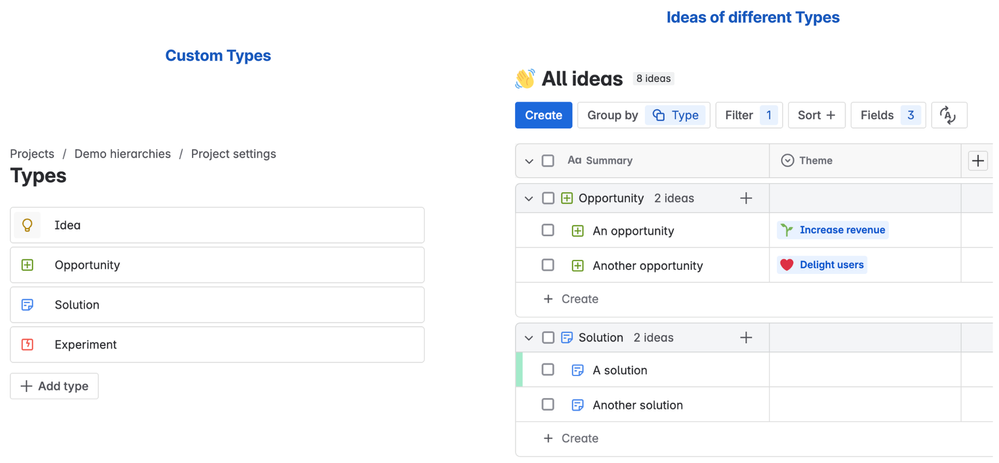
Jira Product Discovery (JPD) hierarchies provide a structured way to organize and visualize your product discovery process. With Custom Types, you can define multiple object types within your project, such as Opportunities, Solutions, and Experiments, to represent different stages or categories of ideas. Connection Fields allow you to create relationships between these types, forming a clear visual structure that mirrors your discovery flow and helps teams see how concepts relate to one another.
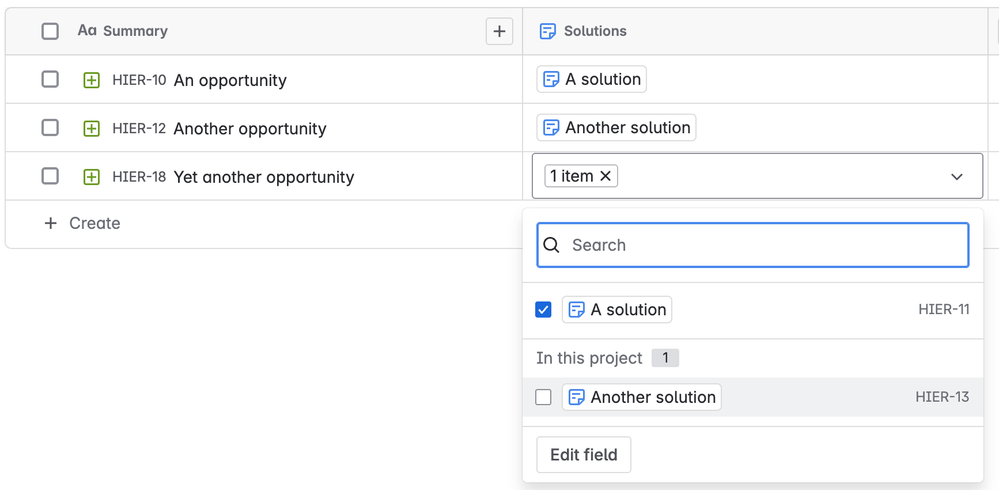
Through Configurable Views, you can visualize these hierarchies in list or board formats. Cross-Project Linking extends this capability by connecting ideas across different JPD projects, ensuring alignment between team-level work and company-wide opportunities. Finally, Automation and Roadmaps leverage these connection fields to drive transparency and consistency. These allow you to use relationships in automation rules and roadmap planning for a unified view of your product portfolio.
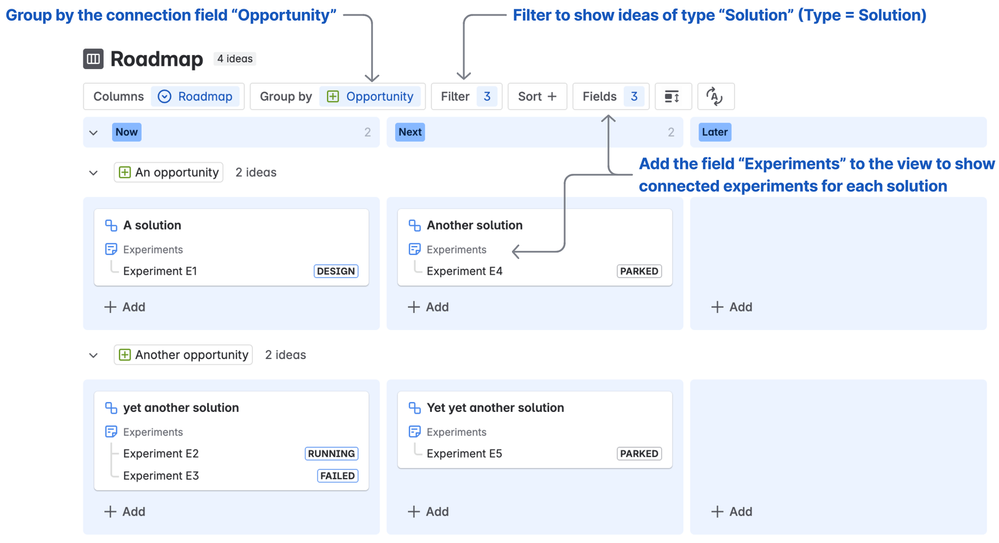
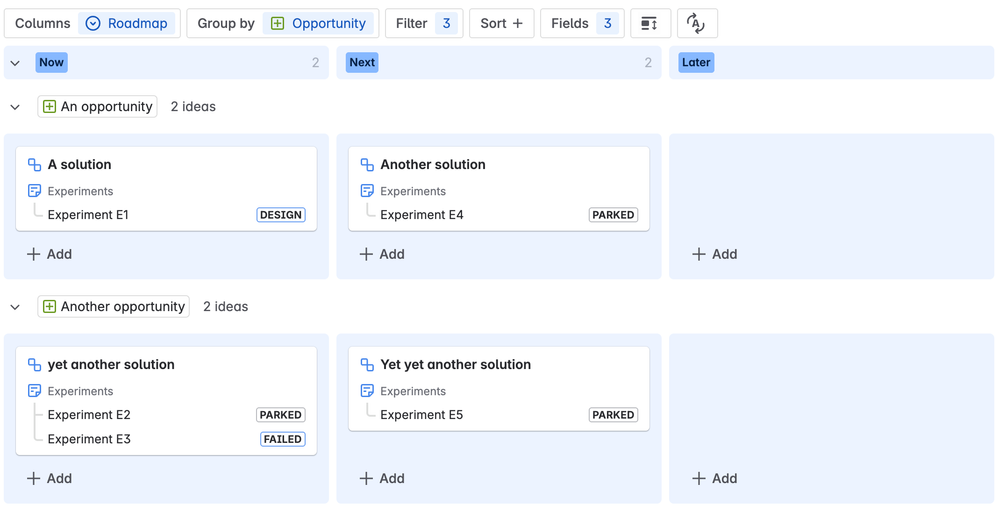
Hierarchies transform how product managers model strategy and execution, offering a clear visual representation of how every solution contributes to business outcomes.
Benefits for Product Managers
With hierarchies and existing JPD features combined, product managers can:
- See the Big Picture: Easily understand how each experiment, feature, or enhancement ladders up to key opportunities and strategic goals.
- Prioritize Intelligently: Use custom scoring formulas and connection fields to evaluate where to invest effort.
- Collaborate Seamlessly: Align stakeholders around shared context and provide visibility into why certain initiatives are prioritized.
- Maintain End-to-End Traceability: Follow ideas from conception through delivery without losing insights along the way.
- Accelerate Validation: Link experiments directly to opportunities and learn faster from real data and outcomes.

By providing both depth (hierarchies) and flexibility (views and fields), JPD makes discovery and prioritization a continuous, data-informed process.
SPK x Atlassian: Enabling Smarter Product Discovery

As an Atlassian Gold Solution Partner, SPK and Associates helps organizations unlock the full potential of Jira Product Discovery and the Atlassian ecosystem. From setup and customization to integration with existing Jira Software and Confluence environments, SPK ensures your teams gain complete visibility from product strategy through delivery.
Whether you’re adopting JPD for the first time or upgrading to Premium to take advantage of hierarchies, SPK’s experts can help you configure, automate, and align your product management workflows for maximum impact.
Getting Started with Hierarchies in Jira Product Discovery
Hierarchies in Jira Product Discovery represent a major leap forward for product managers seeking structured, connected, and transparent discovery processes. This update empowers teams to think strategically and deliver efficiently. With SPK and Associates as your Atlassian implementation partner, you can confidently harness these capabilities, turning ideas into actionable, insight-driven outcomes. If you would like to implement Jira Product Discovery, contact us today.